Write, psychologist, write more!
Why writing psychological assessment reports is an underrated training ground for clinicians. A memory from fifteen years ago, several hundred documents later.
“In my darkest dreams I never expected it to take this long,” wrote someone I mentor, a colleague at the start of her professional life, whom I support in her assessment work. She is in the middle of writing a psychological assessment report. My first reaction was not “I’m sorry” or anything of that kind. My first thoughts were about something far more positive. There was no sympathy in them, although a certain kind of sympathy arrived later, together with admiration and pride in her persistence. The first thought was different. What went through my mind was roughly: “well, yes, this is exactly the sort of moment where becoming a good clinician begins.”
At the moment I accompany several younger colleagues in their professional development. Incidentally, few things give me as much satisfaction as sharing what I know. Before I decided to become a psychologist, I was preparing to be a teacher. And it is that period of my life we are going to revisit today. Let us go back roughly fifteen years, to a few words I heard at the time, with no idea how strongly they would shape the way I think about writing anything at all 🙂
There are few experiences in my life that I remember as precisely as the situation in which those words were said. I can clearly see the corridor on the second floor of the Kazimierz Wielki University building on Grabowa Street, the open door, students walking into the room. In fact, it seems to me that each time I call that situation to mind, I remember it more vividly. One could make a digression about memory here, incidentally. Every retrieval of a trace both consolidates and modifies it, so after this many retrievals it is entirely possible that it did not happen that way at all. Let us say that it did.
Fifteen years ago I was studying applied linguistics alongside psychology and was involved in the work of the psycholinguistics student society. Dr Elżbieta Łukasiewicz, who supervised the society, replied to one of my questions by telling me to write down what I had just said to her. I asked why. I was probably wondering, automatically, whether this was praise or veiled criticism. She answered that “thoughts become more concrete in the course of writing”. That was all. A few words that etched themselves into my brain, although at that moment they did not look like anything that would stay with me for fifteen years. Nor did I think I would be quoting them now, even though I sensed I would share them publicly in some text or other. I have lost count of how many times I have recalled those words with satisfaction in my head – “well, yes, she was right”.
Those of you who write regularly may shrug at this point and think it is rather obvious. I should add that those words did not turn me into someone who writes with enthusiasm. Writing is still, for me, something of a gift from the heavens – it arrives spontaneously, under unforeseen circumstances. This blog is the best evidence of that 🙂 It is easier now, because I can go for a walk and dictate most of a text, then get some help from an LLM with editing it, read it through, and it is done.
It was not that easy in the past. I had to write, because writing was part of being educated or part of doing the job. First academic papers and dissertations. And then the more pleasant of the unpleasant tasks – the need to put assessment work down on paper, because soon after graduating I moved quickly into assessment work. Psychological assessment reports were once a great drama for me. I absolutely understand that association with “darkest dreams”. I put every report off to the last possible moment. Many of you probably know how that feels. And how is it now? Sitting down to write a report is still difficult for me compared with the eagerness with which I sit down opposite the person being assessed in order to gather the material for that report, but a great deal has changed.
These days I draw most of my conclusions with far more satisfaction and confidence, and it is an enjoyable process. Let me say at once that many assessment situations still surprise me. And rightly so, because the day they stop will be the day I start to find this work boring. But naming things comes to me far more easily now, and I know where that came from. From several hundred documents written.
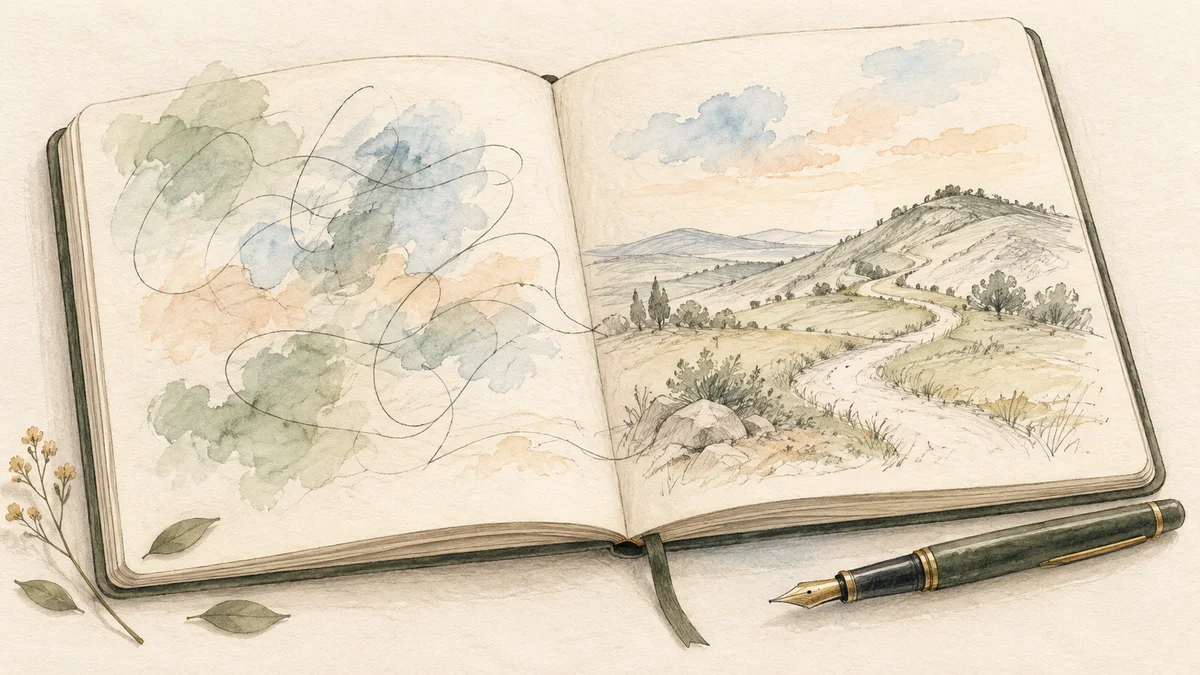
A report is not written at the speed of writing, but at the speed of thinking. The hours we count as a cost are exactly the part of the work in which you have to decide what you know about this person and what you are merely surmising. A thought set down on paper runs in a different channel, and suddenly you can see the places where it dries up. Writing, even about the very thing we were thinking about a moment earlier, activates different associative networks and widens the landscape a little. She was right. She simply did not add how long it takes.
I believe that writing reports helped me develop substantially, not only in psychological assessment but also in psychological treatment, in psychotherapy. Why? Among other reasons, because, as she said – then a doctor, now a professor – thoughts become more concrete. You have to think harder before you say or write something. On paper you can see that the arguments are sometimes missing. It is easier to set them against one another, to list contrasting conclusions side by side. They become more testable, more clearly named, in a sense more true. It teaches me humility towards my own thoughts and associations.
Writing down reflections about a patient and about the therapy can be of great value. I think that preparing write-ups for supervision, even short ones, alongside presenting your work as audio or video recordings, is one of the best forms of preparation for this job. I did exactly that recently and summarised a year of work with a patient. My first words in that supervision session were roughly: “listen, when I read this out to you, I am curious whether you will have the feeling that this is the same patient I have been describing until now.” Having heard the material, the group did not have the feeling that it was a different person, but I felt that something had been escaping me earlier, and supervision confirmed it. That does not mean things had been going badly before. For me it is more a starting point for a reflection that there is something in writing our thoughts down that our profession underestimates and that is very helpful in professional development.
I have one more thought for younger colleagues. There is something perverse about this. It is easy to spend a lot of money on a one-day course, from which little sometimes remains, because there is no occasion to apply it. It is hard to believe that a few hours spent on a single report, possibly unpaid by anyone (because this work is often not adequately paid), can be the better investment. Writing reports is a training ground, and a badly underrated one. If a report writes itself, it means either that there was nothing to think about, or that we did not think.
Bibliography
Applebee, A. N. (1984). Writing and reasoning. Review of Educational Research, 54(4), 577–596. https://doi.org/10.3102/00346543054004577
Galbraith, D. W., & Baaijen, V. M. (2018). The work of writing: Raiding the inarticulate. Educational Psychologist, 53(4), 238–257. https://doi.org/10.1080/00461520.2018.1505515
Kellogg, R. T. (2001). Writing process, psychology of. In N. J. Smelser & P. B. Baltes (Eds.), International Encyclopedia of the Social & Behavioral Sciences (pp. 16629–16633). Elsevier. https://doi.org/10.1016/B0-08-043076-7/01562-X
Loftus, E. F. (2005). Planting misinformation in the human mind: A 30-year investigation of the malleability of memory. Learning & Memory, 12(4), 361–366. https://doi.org/10.1101/LM.94705
Pickel, K. L. (2004). When a lie becomes the truth: The effects of self-generated misinformation on eyewitness memory. Memory, 12(1), 14–26. https://doi.org/10.1080/09658210244000072
Seamon, J. G., Blumenson, C. N., Karp, S. R., Perl, J. J., Rindlaub, L. A., & Speisman, B. B. (2009). Did we see someone shake hands with a fire hydrant?: Collaborative recall affects false recollections from a campus walk. American Journal of Psychology, 122(2), 235–247. https://doi.org/10.2307/27784394
Thomas, A. K., Bulevich, J. B., & Loftus, E. F. (2003). Exploring the role of repetition and sensory elaboration in the imagination inflation effect. Memory & Cognition, 31(4), 630–640. https://doi.org/10.3758/BF03196103