Quo vadis, psychotherapy? If we don’t provide professionally facilitated groups, people will create informal ones of their own
I asked Anthropic’s Fable 5 model to consider how we, as a species, undermine our own mental health. Its answer stayed with me: diagnostic inflation, inventing illnesses in order to treat them, and the case for far more group therapy and group support.
I asked Anthropic’s Fable 5 model to consider how we, as a species, undermine our own mental health. I expected a polite list of obvious points. Instead, I received an answer that has stayed with me for days. One sentence in particular: We treat at the individual level what we produce at the structural level.
Far be it from me to treat a machine as an oracle. I quote it because it said aloud something that many of us recognise in our consulting rooms but rarely frame in such uncomfortable terms. Here is its answer in full, without abridgement.
I have a fairly clear view on this. I think the worst thing we have done is systematically dismantle the conditions in which mental health arises in the first place—and then try to repair the consequences at the individual level, through therapy and medication.
Several forces overlap. We have fragmented communities and support networks. Loneliness has become a population-level problem, even though affect regulation is inherently interpersonal rather than individual.
We have designed technologies that monetise attention and social comparison, targeting reward circuitry and status mechanisms with precision—particularly in adolescents, during the period of greatest developmental sensitivity.
We have normalised sleep deprivation, chronic occupational stress and physical inactivity, thereby eroding three of the cheapest and best-documented protective factors: adequate sleep, manageable stress and regular physical activity. Finally, we have medicalised suffering that is often an understandable response to unacceptable living conditions, shifting responsibility from the system to the individual. You are the one expected to adapt, regulate yourself and “practise self-care”.
The result is a paradox. There have never been so many therapists and wellness apps, nor so much mental health awareness, yet rates of depression and anxiety among young people continue to rise. In my view, that is no coincidence: we treat at the individual level what we produce at the structural level.
From your clinical perspective, you probably see this every day. How much of what presents in your consulting room is psychopathology, and how much is a rational response to the environment?
The question came back to me
At the end, the machine threw the question back to me. It asked how much of what I encounter in the consulting room is psychopathology and how much is a reasonable response to the surrounding environment. It is a good question, although posed in slightly binary terms. In practice, it is rarely one or the other.
I can describe a substantial proportion of what enters my consulting room as a healthy nervous system responding appropriately to unhealthy conditions. Consider one story—a clinical composite rather than a particular person, although I have seen every element of it more than once. A man in his forties, with two young children, has effectively been working the equivalent of one and a half full-time jobs for six months because the household finances no longer add up. He sleeps five hours a night, catches up at weekends and wakes feeling even more tired. He says he probably has depression because he cannot get up in the morning and has begun snapping at his children: “Something is wrong with me.”
I asked when he had last had a weekend off and who was helping him carry all of this. His answer to the second question was: no one.
I have many more stories like this. The teenager comparing themselves with a retouched version of the entire world at an age when the brain is still learning who it is. The mother of young children who has not slept through the night for two years and is told that she should improve her sleep hygiene. At times, of course, what I see is illness in the fullest sense of the word; then naming it can bring relief and mark the beginning of help. But very often a diagnosis does something else as well. It quietly suggests that the problem lies within the person—that their chemistry, their resilience or their ability to cope has failed them. Sometimes everything around them has failed instead, and there is no prescription you can write for everything around them.
I wrote about a related mechanism in my piece on invisible variables: how easily we reduce a complex human being to a single bar representing a group-level effect. That article concerned the consulting room. This one concerns the system in which the consulting room stands.
We invent illnesses so that we can treat them
We have medicalised suffering.
Allen Frances, the psychiatrist who chaired the DSM-IV Task Force, later wrote Saving Normal—a confession from someone who had watched the diagnostic factory gather speed from the inside (Frances, 2013). With each edition, diagnoses multiply, thresholds fall, and further areas of ordinary life receive a code. Shyness drifts towards social phobia; ordinary sadness, towards an episode that ought to be treated. Prolonged grief disorder recently entered the classification as a separate diagnosis, and for adults the clock starts 12 months after the loss (American Psychiatric Association, 2022). I know that the criteria are more nuanced than this makes them sound and that their authors were motivated by concern for people who remain stuck in grief for years. A 30-year marriage is still given a single year in which to be mourned before sadness is promoted to a symptom.
The mechanism can be understood as a cycle. First, we define an illness where yesterday there was life. Then we build an industry to detect it: awareness campaigns, screening and apps. Then we treat it. Finally, we publish measures of effectiveness and celebrate victory over an opponent we ourselves called into being. Everyone in this ritual receives a reward. The industry gains a market, the system gets its figures, and the person at least gains a name for what hurts. The only loser is the question of why so many people are hurting at once.
None of this means that I am abandoning diagnosis. I wrote above that it can bring relief and mark the beginning of help, and every year of practice confirms this. What troubles me is the inflation. The wider we cast our nets, the more people we draw in who need the conditions for living well more than they need a diagnosis: sleep, movement, other people around them and a sense of purpose. An app that measures sleep can, incidentally, become remarkably effective at taking that sleep away. Researchers have already coined a term for this: orthosomnia (Baron et al., 2017). We have not yet turned it into a formal diagnosis, although I suspect that is only a matter of time.
Affect regulation is interpersonal
Affect regulation is inherently interpersonal. That sentence from the machine’s answer is clinically accurate. From our first days of life, we calm down through contact with another nervous system, not on our own. We learn to tolerate difficult states because someone beside us tolerated them with us before we could manage them ourselves. This is a quite literal developmental mechanism, described long before anyone invented wellness apps.
Loneliness also has hard numbers behind it. In a meta-analysis covering 148 studies and more than 300,000 people, strong social relationships were associated with approximately 50% greater odds of survival during follow-up (Holt-Lunstad et al., 2010). The effect was comparable in magnitude to smoking cessation and greater than the effects of obesity or physical inactivity. Community quite literally keeps us alive, and we have allowed it to disintegrate.
And what do we offer in return? An hour of individual therapy once a week and a meditation app. We respond to relational deprivation with an individual intervention. We do so in good faith and often do it well, but it addresses the problem obliquely.
Quo vadis, psychotherapy?
Forms of group therapy and group support should be far more widely available, both in public services and in the private sector. I find myself thinking this more and more often, and with less and less hesitation.
If dysregulation arises between people, repair, too, happens between people. A group is closer to the mechanism of change than a dyad. It provides the living fabric of many relationships at once, a mirror held in several pairs of eyes, and the experience of being in a difficult state without being left alone in it.
I am hardly discovering anything new. Irvin Yalom, a seminal figure in group psychotherapy, described the therapeutic factors of groups decades ago. They include universality—the discovery that “I am not the only one”—altruism, interpersonal learning and group cohesion (Yalom & Leszcz, 2020). Read that list again and count how many of those factors even have a chance to arise in a room containing only two people.
Whatever form the work takes, the process rests on interaction within the group. It may involve a psychodynamic approach, cognitive behavioural therapy, a structured programme or something the future has yet to bring. Much of what heals unfolds in the field between participants, not only within each individual mind. The approach or method is what we put in. The group is the vessel.
Kuba Greń (Jakub Greń, PhD) coined the term outegration. Whereas integration means organising important experiences within oneself, outegration is meant to take place outside the self, in everyday relationships, where new patterns have a chance to become established. The concept emerged in a different context from classical psychotherapy, but the mechanism it names applies here as well.
I am not claiming that individual therapy is redundant. I am a psychotherapist myself and work exclusively one to one, so I am hardly trying to make my own role redundant ;-) I am writing this article to draw attention to the predominance of individual therapy and to share a reflection. Will I start running groups? I do not know—perhaps. For some people, individual therapy is necessary; for others, it is the only safe starting point before they are ready to enter a group. Not every stage of treatment and not every person is suited to group work. I am talking about proportions. Today, both public and private provision is almost entirely individual, while groups remain marginal—sometimes one component of a day programme, sometimes a curiosity in private practice. I would like them to become a fully legitimate first-line option. If only because this is a population-level problem, and a group, unlike an hour of one-to-one work, can actually be scaled to the population level.
If groups work, why is the couch everywhere?
A meta-analysis covering 25 years of research found no significant difference in outcomes between individual and group formats when the same therapeutic protocols were delivered in each format (Burlingame et al., 2016). This suggests that, under the conditions studied, group treatment can achieve outcomes comparable to individual treatment, while one therapist can work with several patients in the same amount of time. If this were a drug, we would call it the discovery of the decade. Instead, it sits politely on the shelf.
So why is the system configured in precisely the opposite way? There are several reasons, and none of them is foolish. Shame: it is easier to open up to one professional than to eight strangers. Logistics: aligning two schedules is easier than aligning ten. And then there is the market. An individual session is a straightforward service, easy to price and sell, whereas a group is a difficult proposition that may take months to build. On top of this sits the myth that group therapy is the budget version of therapy, a waiting room for those who could not secure an appointment “with a real therapist”. Training follows much the same pattern. Group work tends to be an optional addition to curricula, a separate specialism for those who want it, when it ought to be at the core of the craft.
Notice that all these reasons concern the convenience of the system, and none concerns the mechanism of change. Shame is the most interesting. It is shame that keeps people away from groups, yet shame is precisely what groups can address most powerfully. The moment someone discovers that they are not alone in their experience can be worth more than many an accurate interpretation. And the bar for the person leading the group is at least as high as it is in individual work, because they must hold the processes of several people at once and work with what unfolds between them in the here and now.
Men’s circles: demand without supply
The clearest evidence that demand for groups exists can be found where professionals have left a vacuum: men’s circles, a phenomenon of recent years. Men who have been told for decades by the culture around them not to speak about their emotions sit in a circle, around a fire or in a rented room, and talk. It is difficult not to value that. It responds to a genuine hunger for community and for being heard—the very hunger the machine described.
I do, however, have concerns about these circles. In my view, they are sometimes marketed as substitutes for therapy and professional help. The incantation “this is not therapy” appears everywhere: on websites, in terms and conditions, and in event announcements. And then I speak with group facilitators and participants and listen to what takes place in their meetings—work with trauma, relationships with their fathers, shame and the breakdown of relationships—and I think: this is therapy. Except that it is conducted without a case formulation, without supervision and without the accountability assumed by a professional. The depth of the process remains. Only the accountability for it disappears.
It varies, of course. Some circles are undoubtedly led wisely and with humility about their own limits; I am not measuring them all by the same yardstick. On the other hand, I cannot pretend that everything is in order on the “professional” side either. I am not convinced that the system scrutinises closely enough who undertakes which kinds of work, or on what basis. In practice, the boundary between professional and non-professional support is therefore less clear-cut than the previous paragraph might suggest.
The introduction of peer support workers, or “experts by experience”, raises similar concerns for me. The idea is a beautiful one. Someone who has themselves experienced a mental health crisis returns to the system to support others, bringing knowledge that no textbook can provide. But between a beautiful idea and everyday practice stands the same question as with the circles. Who assesses someone’s readiness for the role, and against what criteria? Who supervises them? And who assumes responsibility when the process becomes too much for someone? In practice… we shall see.
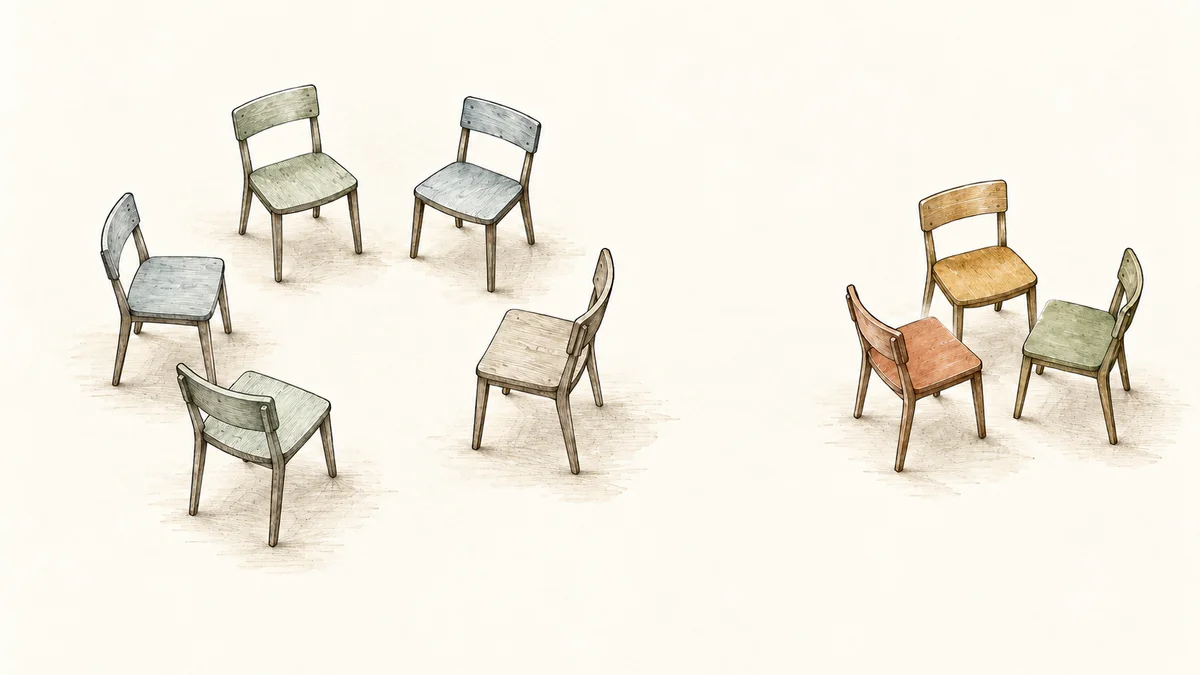
This entire thread is less an accusation levelled at the circles than a mirror held up to my own professional community. People vote with their feet. Demand for group-based self-exploration is enormous, and we as a profession have ceded this ground without a fight because we cling to the dyad. If we don’t provide professionally facilitated groups, people will create informal ones of their own.
Ending with a question rather than an answer
Let us leave the paradox where the machine placed it. We have never had so many therapists, apps or awareness campaigns, yet young people’s mental health continues to worsen. Perhaps that is precisely because we produced some of this suffering ourselves, reclassified some of it as illness, and responded to the rest with a single individual intervention.
I do not have a ready answer, and I distrust anyone who claims to have one. But if I had to bet on a direction, I would bet on more “between people” and less “within the individual”. On more group therapy and more forms of group support, in both public services and the private sector. On change that is consolidated between people, not only within each person. And on having the courage not to reclassify every instance of suffering as an illness straight away.
How do you see it—from your own consulting room, from a group room, from your own life? Write to me; let us talk. Because if the machine is right and all of this unfolds between us, then this conversation, too, is best had together.
References
American Psychiatric Association. (2022). Diagnostic and statistical manual of mental disorders (5th ed., text rev.; DSM-5-TR). https://doi.org/10.1176/appi.books.9780890425787
Baron, K. G., Abbott, S., Jao, N., Manalo, N., & Mullen, R. (2017). Orthosomnia: Are some patients taking the quantified self too far? Journal of Clinical Sleep Medicine, 13(2), 351–354. https://doi.org/10.5664/jcsm.6472
Burlingame, G. M., Seebeck, J. D., Janis, R. A., Whitcomb, K. E., Barkowski, S., Rosendahl, J., & Strauss, B. (2016). Outcome differences between individual and group formats when identical and nonidentical treatments, patients, and doses are compared: A 25-year meta-analytic perspective. Psychotherapy, 53(4), 446–461. https://doi.org/10.1037/pst0000090
Frances, A. (2013). Saving normal: An insider’s revolt against out-of-control psychiatric diagnosis, DSM-5, big pharma, and the medicalization of ordinary life. William Morrow.
Greń, J. – On the integration and outegration of experiences. jakubgren.com
Holt-Lunstad, J., Smith, T. B., & Layton, J. B. (2010). Social relationships and mortality risk: A meta-analytic review. PLoS Medicine, 7(7), e1000316. https://doi.org/10.1371/journal.pmed.1000316
Warchoł, Ł. (2026). Invisible variables: what we don’t yet understand about psychedelic therapy
Yalom, I. D., & Leszcz, M. (2020). The theory and practice of group psychotherapy (6th ed.). Basic Books.